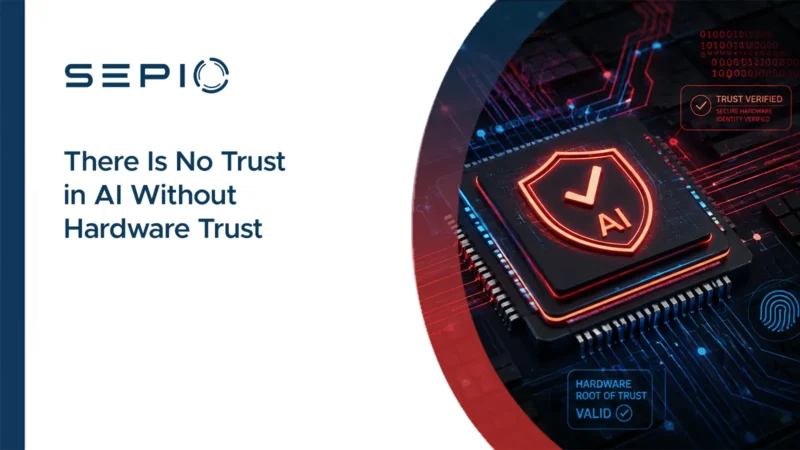
Why Securing Enterprise AI Must Begin With the Endpoint Beneath It
Hardware trust is the foundation of trusted AI. As enterprises adopt AI PCs and other intelligent endpoints, AI device trust becomes essential for ensuring that AI systems operate on verified and secure hardware environments.
For years, endpoint modernization was largely measured through improvements in performance, mobility, battery life, manageability, and user experience. AI PCs introduce something fundamentally different: the endpoint is becoming an active part of the enterprise AI infrastructure, making AI infrastructure security increasingly important.
Equipped with dedicated neural processing units, increasingly powerful CPUs and GPUs, and software designed to execute AI workloads locally, AI PCs can process more information directly on the device. They can support real-time analysis, content generation, intelligent automation, language processing, image enhancement, meeting assistance, and other emerging use cases without depending entirely on cloud-based computing.
This creates significant opportunities for enterprises. However, it also introduces new security challenges.
Local AI processing can improve response times, reduce reliance on continuous cloud connectivity, support offline use cases, and help organizations maintain greater control over certain types of sensitive information.
Why AI Security Must Start at the Endpoint
As more data, processing, models, prompts, and business decisions move to the device, it becomes increasingly valuable, and the consequences of trusting the wrong device become increasingly serious.
Before organizations can trust the AI running on a PC, they must first be able to trust the PC itself. Establishing AI device trust requires organizations to verify both the endpoint and the hardware connected to it.
That is why there is no trust in AI without hardware trust. In practice, this means that AI security must begin with verifying the environment on which AI workloads operate and establishing AI device trust.
AI is Moving Closer to the Data
The traditional enterprise AI model has largely centred on cloud platforms and centralized data centres. Users send requests to a remote service, the service processes the information, and the result is returned to the endpoint.
AI PCs begin to redistribute that model. Some AI workloads can now be executed directly on the device through CPUs, GPUs, and dedicated NPUs. This enables enterprises to move selected AI functions closer to users, business processes, and locally stored data.
This can provide important operational and privacy benefits. However, it also means that enterprise endpoints may increasingly contain or process:
- Sensitive prompts and user interactions
- Local model files and configurations
- Proprietary business documents
- Customer and employee information
- Authentication tokens and application credentials
- Locally generated summaries and recommendations
- Cached datasets and embeddings
- Intellectual property
- Confidential communications
- AI-assisted business decisions
The AI PC is therefore no longer merely a doorway to the organization’s systems. It is becoming a distributed processing environment in its own right. As a result, this changes what enterprises must protect.
Why Endpoint Trust Matters for AI
Without AI device trust, organizations may unknowingly allow AI workloads to run on systems with unauthorized, compromised, or unverified hardware. Security teams must continue securing identities, applications, operating systems, models, networks, and data, but that is no longer sufficient. They must also establish trust in the physical endpoint environment where AI assets are accessed, processed, and executed.
- An AI application may be approved
- The user may be authenticated
- The operating system may be fully patched
- The endpoint detection and response agent may be running correctly
- Yet an unauthorized device could still be connected to the system
That device may be capable of extracting data, introducing a new communications path, automating input, impersonating an approved peripheral, or creating an exposure that traditional software-centred controls were not designed to identify.
The Endpoint Trust Assumption
Most enterprise security architectures contain an important assumption:
Once a corporate endpoint has been provisioned, enrolled, authenticated, and protected by the expected security software, the hardware associated with that endpoint is treated as trustworthy.
In many cases, that trust remains in place until something obvious changes.
But the physical environment around an endpoint is not static. Users connect docking stations, storage devices, keyboards, headsets, cameras, network adapters, mobile devices, hubs, monitors, smart-card readers, and specialized peripherals. Components are repaired or replaced. Devices are reassigned. Employees work remotely (WFH). Contractors connect equipment. Systems pass through warehouses, service centres, offices, homes, airports, and shared workspaces.
Every connection and every hardware change introduce a potential trust decision.
The Limits of Device-Reported Identity
The problem is that many security technologies evaluate devices according to what those devices report about themselves. A peripheral may present a vendor identifier, product identifier, serial number, device class, MAC address, or operating-system descriptor. Those identifiers help the operating system determine how the device should be treated.
But a declared identity is not necessarily a verified identity.
- A device that identifies itself as a keyboard may not be an ordinary keyboard
- A network interface displaying an approved manufacturer’s information may not be the expected network interface
- A replacement peripheral may use the same product identifiers as the original but possess different underlying characteristics
- A composite device may perform more functions than the user or security team expects
This Creates a Fundamental Zero Trust Question:
Are we trusting the device because we have verified what it is, or because we have accepted what it claims to be? For conventional endpoints, that distinction is already important. For AI PCs processing sensitive enterprise information locally, it becomes essential.
The Missing Layer in AI Security: Hardware Trust
Enterprise AI security is often discussed through several important domains:
- Model security
- Data privacy
- Prompt protection
- Access governance
- Application security
- Responsible AI
- Model provenance
- Output integrity
- Cloud security
- Regulatory compliance
All of these deserve attention. However, they are built on top of infrastructure. An AI system depends on processors, memory, firmware, operating systems, interfaces, peripherals, networks, and physical devices. If the underlying environment cannot be verified, trust in the AI system remains incomplete.
Organizations therefore need to ask:
- Is this the expected AI endpoint?
- Does its current hardware configuration match the approved baseline?
- Have components or peripherals changed?
- Are all connected devices authorized?
- Is a device’s observed identity consistent with its declared identity?
- Has an unusual or previously unseen hardware asset appeared?
- Is there an unauthorized communications interface connected to the system?
- Can the organization enforce policy when hardware risk is detected?
- Can the organization demonstrate the endpoint’s hardware posture during an audit or investigation?
These questions define the hardware layer of AI trust. Together, they form the foundation of AI device trust, helping organizations verify that AI-enabled endpoints and connected hardware operate within approved security policies.
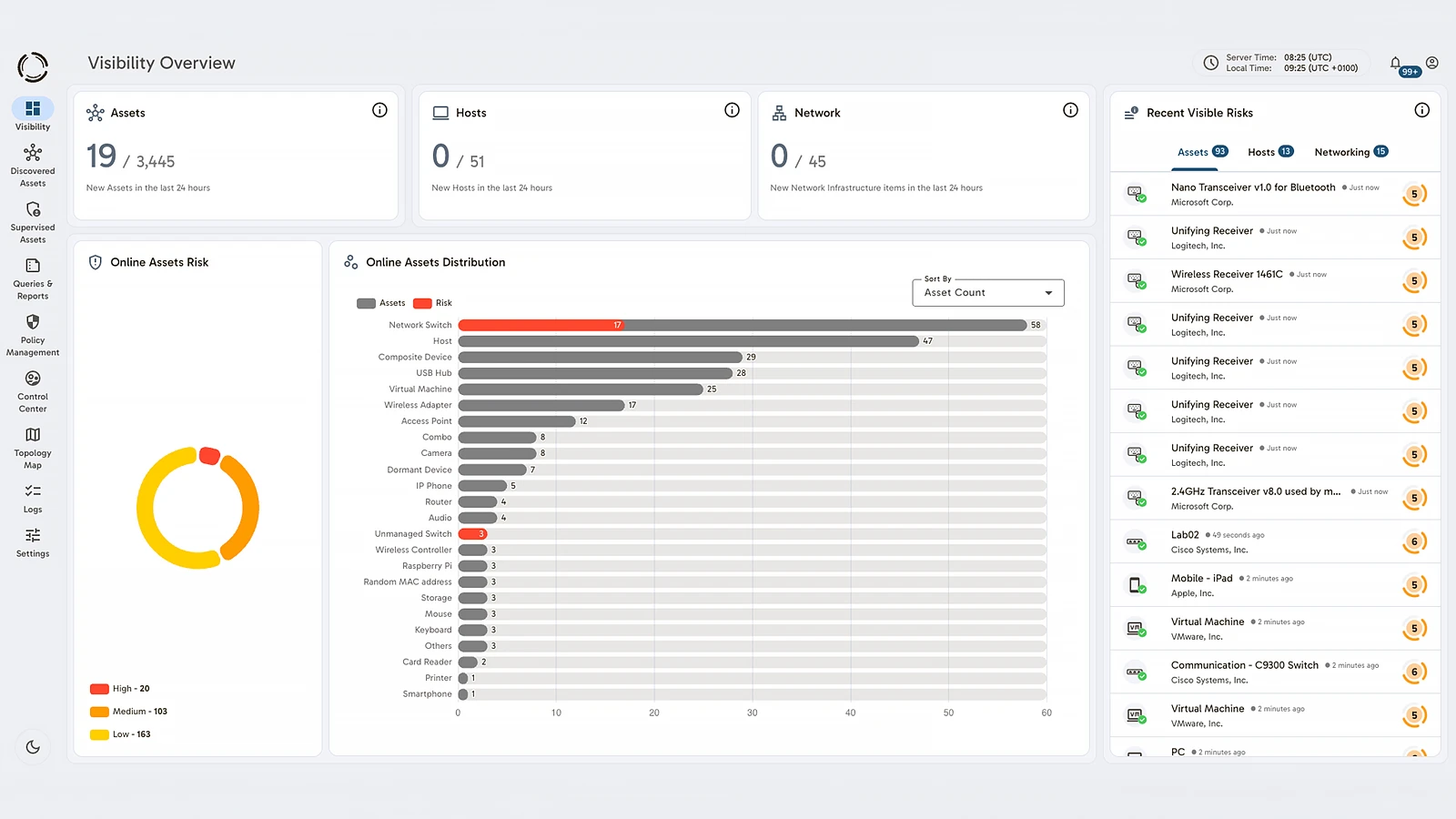
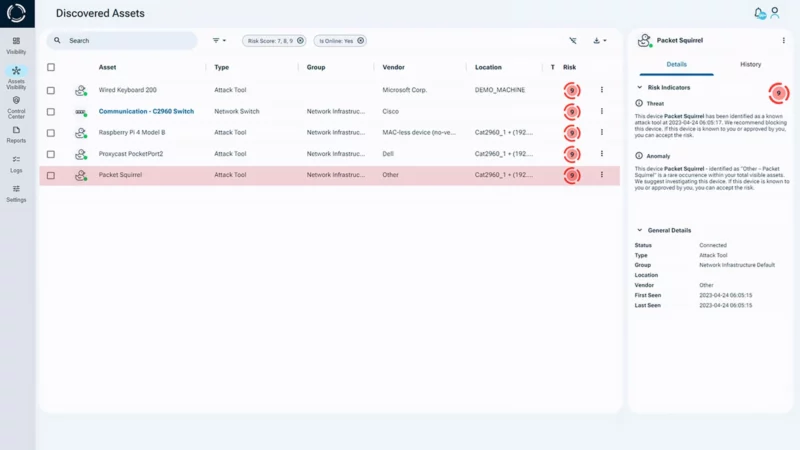
Answering these questions requires visibility into the hardware assets connected across the environment. The example below illustrates how hardware visibility can provide a real-time view of connected assets, their identities, and associated security risks.
Why Existing Security Controls Need Hardware Trust
Modern enterprise PCs already include important security capabilities. Depending on the system and its configuration, these may include:
- Secure Boot
- Trusted Platform Module capabilities
- Firmware protection
- Hardware-backed credentials
- Disk encryption
- Endpoint detection and response
- Identity and access management
- Device management
- Data-loss prevention
- Application control
- Network access control
These controls can help protect:
- The boot process
- Firmware
- Cryptographic keys
- Credentials
- Stored data
- The operating system
- Applications and processes
- User identities
- Network access
- Endpoint configuration
They remain vital to a secure AI PC architecture. However, these layers do not always answer a different question: What hardware is actually connected to the endpoint, and can it be trusted?
Endpoint detection and response primarily focuses on software activity and operating-system behaviour.
- Identity systems verify users and services
- Network access control governs access to the network
- Device-management platforms enforce endpoint configuration
- Firmware technologies protect the system’s boot and firmware environment
- AI governance platforms focus on models, data, applications, and responsible use
Hardware trust complements these controls by continuously identifying and assessing the physical devices and peripherals associated with the endpoint.
It is not a replacement for endpoint security. It is the layer that helps close the gap between the logical identity of a device and its actual hardware identity.
Extending Zero Trust Through Hardware Trust
Zero Trust is often summarized through the principle “never trust, always verify.” Yet device verification frequently remains centred on certificates, operating-system posture, management status, software agents, and network identity. These indicators matter, but they do not necessarily verify every hardware asset connected to the endpoint. A true Zero Trust architecture (ZTA) should not automatically trust a peripheral simply because:
- It is connected to a corporate PC
- It presents a familiar manufacturer name
- The operating system recognizes its device class
- It uses an approved driver
- It appears on an allowlist
- A similar device was previously approved
Instead, trust should be based on stronger and continuously evaluated evidence. This is the foundation of Zero Trust Hardware Access (ZTHA):
- Discover the connected asset
- Establish its hardware identity
- Compare its observed characteristics with the expected profile
- Assess the risk it introduces
- Apply the appropriate policy
- Continue verifying it throughout its lifecycle
In this model, hardware is not trusted permanently because it was approved once. Trust is continuously earned.
Sepio’s Role in Trusted AI Endpoints
Sepio provides hardware asset intelligence designed to help organizations identify, verify, assess, and control the devices connected across their environments. At the endpoint level, this includes visibility into connected peripherals and the creation of a Hardware Bill of Materials (HBOM).
Rather than depending only on the identity that a device declares through standard software-visible attributes, Sepio’s AssetDNA™ approach examines additional characteristics associated with the physical device. This can help security teams differentiate between:
- A known and expected device
- A newly connected but legitimate asset
- An unauthorized peripheral
- An unknown device requiring investigation
- A device presenting misleading identity information
- A rare or anomalous asset
- A device whose observed characteristics differ from the approved baseline
Sepio applies machine-learning-based analysis to support hardware classification, fingerprinting, anomaly identification, and risk prioritization. This is an important distinction. Sepio does not need to claim that generative AI is the centre of its platform.
Its role is more fundamental: Sepio helps secure the hardware environment on which enterprise AI depends. That position is both credible and strategically important. As organizations deploy more AI PCs, they will need to understand not only which systems support AI workloads, but whether those systems remain in a trusted hardware state.
What AI Endpoint Security Should Provide
A trusted AI endpoint should be more than an AI-capable PC with security software installed. It should provide continuous evidence that the hardware foundation remains known, expected, and compliant.
Verified Endpoint Identity
The organization should be able to determine whether the system matches its expected hardware identity and configuration. This may include validating the endpoint against an approved baseline established during provisioning or deployment.
A Current Hardware Bill of Materials
Security and IT teams should have visibility into relevant hardware components and connected peripherals. The HBOM should reflect what is observed in the environment, not merely what was recorded in a procurement or configuration database.
Peripheral Discovery and Classification
The organization should be able to identify connected devices such as:
- USB storage
- Keyboards and pointing devices
- Cameras and microphones
- Docking stations
- Network adapters
- USB hubs
- Audio devices
- Smart-card readers
- Mobile devices
- Specialized peripherals
- Composite devices
Hardware Anomaly Detection
The system should identify unusual conditions, including devices whose observed characteristics do not match their expected identity.
Configuration-Drift Detection
Hardware changes should be identified following repair, replacement, reassignment, upgrade, or physical access.
Risk-based Policy
Not every new device represents the same level of risk. An unfamiliar peripheral connected to a standard office endpoint may require investigation. The same device connected to an executive system or an AI workstation containing sensitive intellectual property may require immediate action. Hardware risk should therefore be evaluated in context.
Enforcement and Response
Visibility alone is not enough. The organization should be able to generate an alert, initiate an investigation, open a service-management ticket, trigger an external security workflow, restrict the device, or apply another appropriate control.
Audit and Governance Evidence
The organization should be able to demonstrate:
- Which hardware was connected
- When it appeared
- How it was classified
- What risk was identified
- Which policy was applied
- What remediation occurred
This turns hardware trust into measurable governance.
How Hardware Threats Can Affect AI PCs
Consider several practical scenarios.
Unauthorized Storage Connected to an AI PC
An employee uses an AI assistant to summarize confidential business documents locally. The resulting files, prompt histories, or cached information remain on the endpoint. An unauthorized storage device is then connected. Even when cloud exposure has been reduced, the data may still be vulnerable at the physical endpoint.
A Malicious Device Posing as a Keyboard
A device presents itself as a standard human-interface device and generates automated commands. To the operating system, it may appear to be an ordinary keyboard. But it could interact with applications, browsers, files, command interfaces, or AI assistants at machine speed.
An Unauthorized Network Path
A user connects a new USB network interface, wireless adapter, docking station, or bridge. The new interface may create communications paths that sit outside the organization’s expected network architecture.
A Modified or Substituted Peripheral
A device retains familiar vendor and product information but no longer matches the expected physical profile. A security policy based only on declared identifiers may continue to trust it.
Hardware Changes After Repair
An AI PC is repaired, upgraded, or serviced. Without a hardware baseline, the organization may not be able to determine whether all changes were authorized or whether the endpoint returned in its expected state.
A Targeted High-Value Endpoint
An executive, engineer, researcher, developer, or analyst uses a local AI system to process sensitive information. A seemingly ordinary connected device may create access to data that never needed to leave the endpoint through the cloud.
These scenarios illustrate an important principle: Local AI can reduce one category of exposure while increasing the importance of endpoint and hardware security.
Why AI PC Security Requires Hardware Trust
For technology providers and enterprise security teams, this creates an opportunity to move beyond the performance conversation. The value of an AI PC is often communicated through:
- NPU performance
- Battery efficiency
- Faster AI processing
- New productivity features
- Local inference
- Improved user experience
- Cloud and device integration
These are meaningful benefits, but enterprise customers will increasingly ask a second set of questions:
- How do we govern these devices?
- How do we protect locally processed information?
- How do we know the endpoint has not changed?
- How do we control connected hardware?
- How do we demonstrate that AI endpoints remain compliant?
- How does the AI PC fit within our Zero Trust architecture?
This is where hardware trust can strengthen the AI PC value proposition. The organization is no longer simply deploying a more powerful endpoint. It is deploying a distributed platform for enterprise AI. That platform requires continuous verification, contextual risk assessment, and enforceable hardware policy.
A trusted AI PC should therefore combine computing performance with security evidence: evidence that the endpoint is known, its hardware is expected, its peripherals are authorized, and changes are identified throughout the device lifecycle.
A Layered Model for AI Endpoint Security
A trusted AI endpoint architecture should consist of several complementary layers.
AI PC Hardware
The foundation includes:
- CPU
- GPU
- NPU
- Memory
- Storage
- Firmware
- Physical interfaces
- Integrated sensors
- Wireless connectivity
Platform Integrity
This layer includes:
- Secure Boot
- Firmware controls
- TPM capabilities
- Hardware-backed credentials
- Disk encryption
- Operating-system integrity
Hardware Identity and Peripheral Trust
This layer includes:
- Endpoint hardware discovery
- Peripheral discovery
- HBOM creation
- Hardware profiling
- Device classification
- Hardware anomaly detection
- Continuous risk assessment
- Policy-based control
Endpoint and Identity Protection
This includes:
- EDR and XDR
- Identity and access management
- Multifactor authentication
- Data-loss prevention
- Application control
- Endpoint management
- Privileged-access controls
AI Application and Model Governance
This includes:
- Approved AI applications
- Approved models
- Model provenance
- Data-use policy
- Prompt and output controls
- Application permissions
- AI risk management
Enterprise Security Operations
This includes integration with:
- SIEM
- IT service management
- Configuration management databases (CMDB)
- Security orchestration
- Asset-management systems
- Compliance reporting
- Incident-response workflows
No individual layer can establish complete AI trust on its own. Together, these layers can create a stronger and more defensible trust architecture.
The Hardware Trust Passport
One of the most promising longer-term concepts is a hardware trust passport for every enterprise AI PC. The passport could begin with the expected hardware identity and configuration established during manufacturing, provisioning, or deployment. Once the device enters the enterprise environment, its observed hardware state could be continuously compared with that expected profile.
The trust passport might include:
- The original approved configuration
- Initial endpoint verification
- Current HBOM
- Connected peripheral history
- Approved hardware changes
- Repair or replacement events
- Detected anomalies
- Current risk status
- Compliance with organizational policy
This would extend trust across the device lifecycle:
Manufacture → Provision → Deliver → Activate → Operate → Repair → Reassign → Retire
Rather than treating hardware trust as a one-time event, the organization gains continuous assurance that the endpoint remains consistent with its intended identity. This model could also help security, IT, compliance, procurement, and supply-chain teams work from a shared record of endpoint hardware trust.
Using AI Language Responsibly
There is a temptation for every security company to reposition itself as an AI company. That is not necessary here. Sepio uses machine learning to support hardware identification and risk analysis. This can be described accurately through terms such as:
- Machine-learning-based hardware identification
- Intelligent device classification
- Automated hardware-risk analysis
- ML-assisted anomaly detection
- Continuous hardware identity verification
- Hardware-risk intelligence
Machine learning can help analyse device characteristics, identify unusual patterns, compare assets with known populations, and prioritize risks at scale. That does not mean the technology should automatically be described as generative AI. The stronger and more defensible message is that Sepio addresses one of AI’s critical dependencies. An AI system can only be as trustworthy as the environment in which it operates.
- The model may be approved
- The application may be secure
- The user may be authenticated
But when the endpoint or connected hardware cannot be verified, the chain of trust remains incomplete.
Hardware Trust: The Foundation of Trusted AI
Enterprises are entering a new phase of endpoint computing. AI PCs will make artificial intelligence more immediate, personal, distributed, and context-aware. They will allow more data to be processed closer to the user and enable use cases that are difficult to deliver through cloud services alone. But moving intelligence to the endpoint also moves responsibility to the endpoint.
Trust Must Extend to the Hardware Layer
Organizations must protect not only the AI model, but the system beneath it.
- They must know which endpoint is running the workload
- They must know which hardware is connected
- They must identify when the hardware environment changes
- They must distinguish between a device’s claimed identity and its verified identity
- And they must be able to enforce policy when trust cannot be established
Effective AI security extends beyond models and applications to include the hardware layer that supports them. It cannot begin with the prompt. It cannot begin with the application. It cannot even begin with the operating system.
It begins with the physical foundation. Before trusting the application, verify the user. Before trusting the AI, verify the endpoint. Before trusting the endpoint, verify the hardware.
There is no trust in AI without hardware trust.
Frequently Asked Questions
An AI PC is a personal computer designed to execute artificial intelligence workloads locally. It typically combines a CPU, GPU, and dedicated neural processing unit, or NPU, to support functions such as inference, content generation, language processing, image analysis, automation, and intelligent user assistance.
Unlike a conventional endpoint that depends primarily on cloud-hosted AI services, an AI PC can process some AI workloads directly on the device.
Hardware trust is the ability to establish confidence that an endpoint and the devices connected to it are known, authentic, authorized, and operating within the organization’s expected hardware policy.
It includes discovering hardware, verifying identity, identifying unexpected changes, assessing risk, and applying controls when trust cannot be established.
Hardware trust should be continuous rather than based only on a one-time provisioning or authentication event.
AI systems depend on physical infrastructure, including processors, memory, storage, firmware, interfaces, and peripherals.
When an organization cannot verify that infrastructure, it cannot fully trust the environment in which the AI workload is operating.
An approved AI application running on an endpoint with an unauthorized peripheral, altered hardware configuration, or unexpected communications interface may still expose sensitive data or create security risk.
Hardware trust helps protect the physical foundation beneath AI applications and models.
The phrase means that AI trust cannot be established only by evaluating the model, application, user, or data.
Organizations must also verify the physical endpoint that executes or accesses the AI workload.
When the endpoint or its connected hardware cannot be identified and assessed, the AI trust chain remains incomplete.
An AI PC is not necessarily less secure than a conventional PC. However, it may become a more valuable target because it can locally process or store sensitive prompts, documents, model data, credentials, and AI-generated business information.
The expanded role of the endpoint increases the importance of validating its hardware configuration and monitoring connected peripherals.
Local AI processing can reduce the amount of information that must be sent to cloud services, but it does not eliminate security risk.
Data processed locally may still be exposed through:
- Unauthorized storage devices.
- Rogue peripherals.
- Malicious human-interface devices.
- Unapproved network adapters.
- Hardware changes.
- Physical access.
- Endpoint compromise.
- Local application vulnerabilities.
Local processing changes the location of the risk. It does not remove the need for security.
An AI PC may locally process or store:
- Prompts.
- AI-generated output.
- Business documents.
- Meeting information.
- Images and audio.
- Customer data.
- Employee data.
- Intellectual property.
- Model files.
- Embeddings.
- Cached application data.
- Authentication tokens.
- Locally generated recommendations.
The specific data depends on the AI applications and use cases deployed by the organization.
A trusted AI endpoint is an AI-capable system whose identity, hardware configuration, peripherals, security posture, and policy compliance can be continuously verified.
A trusted AI endpoint should provide evidence that:
- The endpoint is the expected device.
- Its hardware configuration matches the approved baseline.
- Connected peripherals are known and authorized.
- Unexpected changes are identified.
- Hardware risk is continuously assessed.
- Policy can be enforced when a risk is detected.
Zero Trust Hardware Access applies Zero Trust principles to physical devices and peripherals.
It requires organizations to discover connected hardware, verify its identity, assess its risk, and apply policy before granting or maintaining trust.
The core principle is that hardware should not be trusted solely because it is connected to a corporate endpoint or presents a familiar identifier.
Device identity often relies on software-visible attributes such as:
- Vendor identifiers.
- Product identifiers.
- Serial numbers.
- MAC addresses.
- USB descriptors.
- Device classes.
- Driver information.
Hardware identity goes further by evaluating characteristics associated with the physical device itself.
This distinction matters because software-visible identifiers may be generic, duplicated, incomplete, or manipulated.
Yes. A malicious or unauthorized device may present identifiers associated with an approved keyboard, storage device, network adapter, or another common peripheral type.
If security policy relies only on those declared identifiers, the device may be misclassified as trusted.
Hardware profiling can provide additional evidence to determine whether the device’s observed characteristics match its claimed identity.
A malicious human-interface device is a connected device that identifies itself as a keyboard, mouse, or similar input device but performs unauthorized automated actions.
Because operating systems generally accept input from recognized keyboards, such a device may generate commands or interact with applications without appearing to be traditional malware.
Hardware identity and device-control policies can provide additional protection against this type of threat.
A Hardware Bill of Materials, or HBOM, is a structured record of the hardware associated with an endpoint or environment.
For an AI PC, an HBOM may include relevant system components and connected peripherals.
An HBOM can support:
- Asset inventory.
- Configuration baselining.
- Change detection.
- Incident investigation.
- Compliance reporting.
- Repair validation.
- Lifecycle management.
- Supply-chain assurance.
A software bill of materials, or SBOM, records software components, packages, libraries, and dependencies.
An HBOM records hardware components and connected physical devices.
Both can support security and supply-chain risk management, but they address different layers of the technology stack.
A hardware trust passport is a lifecycle record of an endpoint’s expected and observed hardware identity.
It may include:
- Original approved configuration.
- Initial verification.
- Current HBOM.
- Peripheral history.
- Approved changes.
- Repair events.
- Hardware anomalies.
- Current risk level.
- Compliance status.
The purpose is to provide continuous assurance from provisioning through retirement.
Hardware trust can strengthen AI governance by providing evidence about the infrastructure on which AI workloads operate.
It can help organizations:
- Identify AI-capable endpoints.
- Validate endpoint configurations.
- Monitor hardware changes.
- Control peripherals.
- Assess endpoint risk.
- Document exceptions.
- Produce audit evidence.
- Integrate hardware risk into broader AI policy.
Hardware trust does not replace model or data governance but can strengthen broader AI risk management programs.
EDR provides essential visibility into endpoint processes, files, software behaviour, and operating-system activity.
However, EDR does not always provide complete verification of the physical identity of connected hardware.
Hardware trust complements EDR by adding device discovery, hardware profiling, HBOM visibility, peripheral-risk analysis, and hardware-level policy enforcement.
Network access control helps determine which devices can connect to an organization’s network and under what conditions.
However, NAC primarily governs network access. It may not identify every connected peripheral, validate the physical identity of a device, or detect hardware attached directly to an endpoint.
Hardware trust complements NAC by extending verification to endpoint peripherals and other hardware assets.
Secure Boot helps prevent unauthorized software from loading during the boot process.
It is an important platform-integrity control, but it does not continuously identify every peripheral attached to the endpoint or determine whether a connected device is authorized.
Secure Boot and hardware trust address different parts of the endpoint security architecture.
A Trusted Platform Module supports functions such as secure key storage, platform measurement, and hardware-backed authentication.
It does not typically identify and continuously assess every connected peripheral.
TPM capabilities and hardware-asset intelligence are complementary controls.
Allowlists can reduce risk by permitting only approved device identifiers or device classes.
However, they may be insufficient when identifiers can be duplicated, manipulated, shared across multiple products, or used by a device that behaves differently from the expected asset.
Combining allowlists with hardware identity verification creates a stronger trust decision.
Relevant hardware threats may include:
- Unauthorized USB storage.
- Rogue keyboards and human-interface devices.
- Malicious composite devices.
- Unauthorized network adapters.
- Modified docking stations.
- Hardware implants.
- Peripheral impersonation.
- Unmanaged hubs.
- Unexpected cameras or microphones.
- Configuration changes after repair.
- Device substitution.
- Alternate communications paths.
The relevance of each threat depends on the endpoint’s users, applications, data, and operating environment.
Hardware trust can help identify and control devices that may extract, transmit, manipulate, or gain access to locally processed information.
This includes detecting unauthorized storage, networking, human-interface, and composite devices connected to AI endpoints.
It can also identify changes from the endpoint’s approved hardware baseline.
No single security control can prevent every AI-related attack.
Hardware trust addresses the physical endpoint and peripheral layer. It should be combined with:
- Identity security.
- EDR and XDR.
- Application security.
- Data protection.
- Model governance.
- Network security.
- Firmware protection.
- Secure configuration.
- User awareness.
- Incident response.
A layered architecture provides stronger protection than any single technology.
Machine learning can support hardware security by helping analyse device characteristics across large populations.
It may be used for:
- Device classification.
- Hardware fingerprint analysis.
- Anomaly detection.
- Rare-device identification.
- Baseline comparison.
- Risk prioritization.
- Detection of unusual hardware patterns.
Machine learning helps security teams analyse hardware at a scale that would be difficult to manage manually.
No. Machine learning is a broad category of techniques that enable systems to identify patterns, classify data, make predictions, or detect anomalies.
Generative AI is a type of AI designed to create new content, such as text, images, audio, or software code.
A security product may use machine learning for classification and anomaly detection without being a generative-AI platform.
Sepio provides hardware asset intelligence, risk analysis, and policy-based control.
It uses machine-learning-based techniques to support hardware identification, classification, anomaly detection, and risk prioritization.
Sepio’s primary role in AI security is not to govern models or evaluate AI-generated output. Its role is to help secure and continuously verify the hardware environment on which enterprise AI depends.
AssetDNA™ is Sepio’s approach to establishing hardware identity through characteristics associated with the physical asset.
It is designed to provide stronger evidence than reliance on standard identifiers alone.
AssetDNA™ can help identify situations in which a device’s observed characteristics differ from its declared or expected identity.
Hardware-risk intelligence is the combination of hardware visibility, identity verification, context, anomaly analysis, and risk prioritization.
It helps security teams move beyond basic asset inventory and determine which hardware conditions require investigation, remediation, or enforcement.
Organizations should establish a hardware baseline when the AI PC is provisioned or first activated in an approved state.
The baseline may include:
- Expected endpoint model.
- Hardware configuration.
- Firmware status.
- Integrated interfaces.
- Approved peripherals.
- HBOM.
- User or department assignment.
- Security-policy group.
The endpoint can then be monitored for changes from that baseline.
When an AI PC is repaired, components may be replaced, firmware may be updated, or peripherals may change.
The organization should compare the returned system with its approved hardware baseline and document legitimate changes.
Unexpected differences should be investigated before full trust is restored.
A device that was trusted at deployment may change later.
Changes can occur through:
- Repair.
- Upgrade.
- Peripheral connection.
- User action.
- Contractor access.
- Device reassignment.
- Supply-chain handling.
- Physical tampering.
- Configuration drift.
Continuous verification helps ensure that trust reflects the endpoint’s current state rather than a historical approval.
Hardware trust can support:
- Security operations.
- Endpoint engineering.
- IT asset management.
- AI governance.
- Risk and compliance.
- Incident response.
- Procurement.
- Supply-chain security.
- Digital workplace teams.
- Internal audit.
- Executive security leadership.
A shared hardware-trust record can improve coordination among these functions.
Hardware trust is especially relevant to organizations that:
- Process sensitive information locally.
- Deploy AI PCs to executives or privileged users.
- Operate in regulated industries.
- Manage distributed or remote workforces.
- Use specialized peripherals.
- Maintain critical infrastructure.
- Handle intellectual property.
- Support defence, government, healthcare, finance, energy, or manufacturing environments.
- Require strong supply-chain assurance.
- Need evidence of continuous endpoint compliance.
Possible metrics include:
- Percentage of AI PCs with verified hardware identity.
- Percentage with a current HBOM.
- Number of unauthorized peripherals detected.
- Number of hardware anomalies identified.
- Percentage compliant with the approved baseline.
- Mean time to investigate hardware risk.
- Mean time to remediate hardware incidents.
- Number of configuration changes reviewed.
- Number of policy actions applied.
- Reduction in unidentified hardware.
These measures can help demonstrate the operational value of hardware-trust controls.
Hardware trust can support compliance by providing evidence of:
- Asset inventory.
- Endpoint configuration.
- Connected-device visibility.
- Policy enforcement.
- Risk assessment.
- Change management.
- Incident handling.
- Remediation.
- Continuous monitoring.
The exact relevance depends on the organization’s industry, location, regulatory obligations, and control framework.
An enterprise AI PC security strategy should include:
- AI use-case governance.
- Data classification.
- Model and application approval.
- Identity and access controls.
- Endpoint protection.
- Platform-integrity controls.
- Hardware discovery.
- Peripheral verification.
- HBOM management.
- Configuration baselines.
- Risk-based enforcement.
- Logging and incident response.
- Compliance reporting.
- Lifecycle management.
Hardware trust should be treated as part of the overall AI security architecture rather than as an isolated feature.
The first step is to establish visibility into the actual hardware environment.
Organizations should identify:
- Which endpoints are AI-capable.
- Which users and use cases are associated with them.
- What hardware is connected.
- Which devices are authorized.
- Whether current asset records are accurate.
- Which endpoints lack a verified baseline.
Once the environment is known, organizations can apply identity verification, risk assessment, policy, and continuous monitoring.
The central principle is simple:
An organization should not trust an AI workload without verifying the endpoint on which it operates, and it should not trust the endpoint without verifying its hardware.
Trusted AI begins with a trusted physical foundation.
Sepio provides the hardware asset intelligence and control layer required to extend Zero Trust to connected devices.
Through trafficless discovery, AssetDNA™ hardware fingerprinting, Hardware Bill of Materials visibility, machine-learning-assisted analysis, continuous risk assessment, and policy-based enforcement, Sepio helps organizations identify known, unknown, unmanaged, and potentially malicious hardware across endpoint and network environments.
Sepio enables enterprises to move beyond assumed device identity and establish Zero Trust Hardware Access (ZTHA) – ensuring that hardware is discovered, verified, assessed, and continuously governed before it is trusted.