Financial institutions are adopting Zero Trust to strengthen access control, reduce cyber risk, and improve resilience across banking, insurance, payments, and capital markets environments. Most Zero Trust programs focus on users, applications, sessions, and network activity. However, one critical layer is often overlooked: the hardware itself.
In financial environments, connected assets can include endpoints, ATMs, branch systems, kiosks, network equipment, peripherals, IoT devices, and third-party hardware. If these assets are trusted simply because they appear legitimate, organizations may remain exposed to rogue, spoofed, unmanaged, or unauthorized devices.
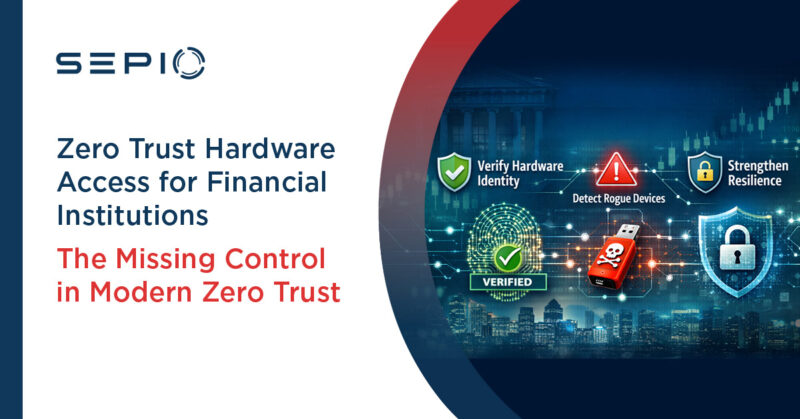
Effective Zero Trust for financial institutions should therefore include hardware visibility and device identity validation. This is where Zero Trust Hardware Access (ZTHA) helps close the gap by verifying what a device truly is before it is trusted to connect, communicate, or operate.
This is especially important in financial services, where cyber resilience, regulatory compliance, third-party risk management, and operational continuity are critical business priorities.
Key Takeaways
- Traditional Zero Trust strategies often assume connected devices are trustworthy.
- Financial institutions face elevated risk from rogue, unmanaged, spoofed, and unauthorized hardware.
- Zero Trust Hardware Access helps verify device identity before trust is granted.
- Hardware visibility strengthens cyber resilience, operational control, and risk reduction.
Why Zero Trust Matters to Financial Institutions
Financial institutions operate in some of the most complex and regulated environments in the economy. Their infrastructures often include branches, ATMs, kiosks, endpoints, trading systems, partner connections, remote access points, IoT devices, and specialized hardware assets spread across multiple locations.
That complexity creates blind spots. And blind spots create risk.
If a financial institution cannot reliably answer what is actually connected, whether it is truly what it claims to be, and whether it should be allowed where it is, then Zero Trust is incomplete.
Sepio’s approach to cybersecurity for financial institutions is built around closing those blind spots with deeper visibility and verified hardware trust.
The Hardware Gap in Zero Trust for Financial Institutions
Most Zero Trust programs focus first on users, sessions, applications, and segmentation. That is important. But if device identity is based on spoofable or incomplete signals, policy decisions are built on a weak foundation.
This is the hardware gap.
It appears when:
- a rogue device presents itself as something benign
- an unmanaged peripheral connects without being fully understood
- a dormant implant sits unnoticed because it is not producing meaningful traffic
- an unauthorized device enters a branch, office, data center, trading floor, or ATM environment
- a known asset changes posture, location, or behavior without triggering enough scrutiny
Zero Trust Hardware Access addresses this by shifting trust from declared device identity to verified hardware truth.
Why Financial Services are Especially Exposed
1. High-value environments
Banks, insurers, payment processors, and investment firms are attractive targets because disruption, fraud, and data compromise all carry outsized business impact.
2. Distributed infrastructure
Financial organizations rarely operate from one centralized environment. They span headquarters, branches, data centers, cloud, remote employees, service providers, and partner ecosystems. That makes consistent device trust harder to maintain.
3. Third-party and supply-chain exposure
Financial services organizations depend on external providers, managed services, and distributed technologies. Hardware visibility and verification become critical when trust must extend beyond directly managed assets.
4. Compliance pressure
Security teams in financial institutions must show that their environments are governed, monitored, and controlled. That requires reliable asset visibility and defensible risk-based controls, especially in light of evolving financial industry regulations.
5. Hidden devices and non-traditional assets
Not every risky device behaves like a managed laptop or server. Financial environments include peripherals, embedded systems, ATM-connected hardware, networking devices, USB-connected assets, and specialized appliances that traditional tools may not identify with confidence.
What Zero Trust Hardware Access Adds
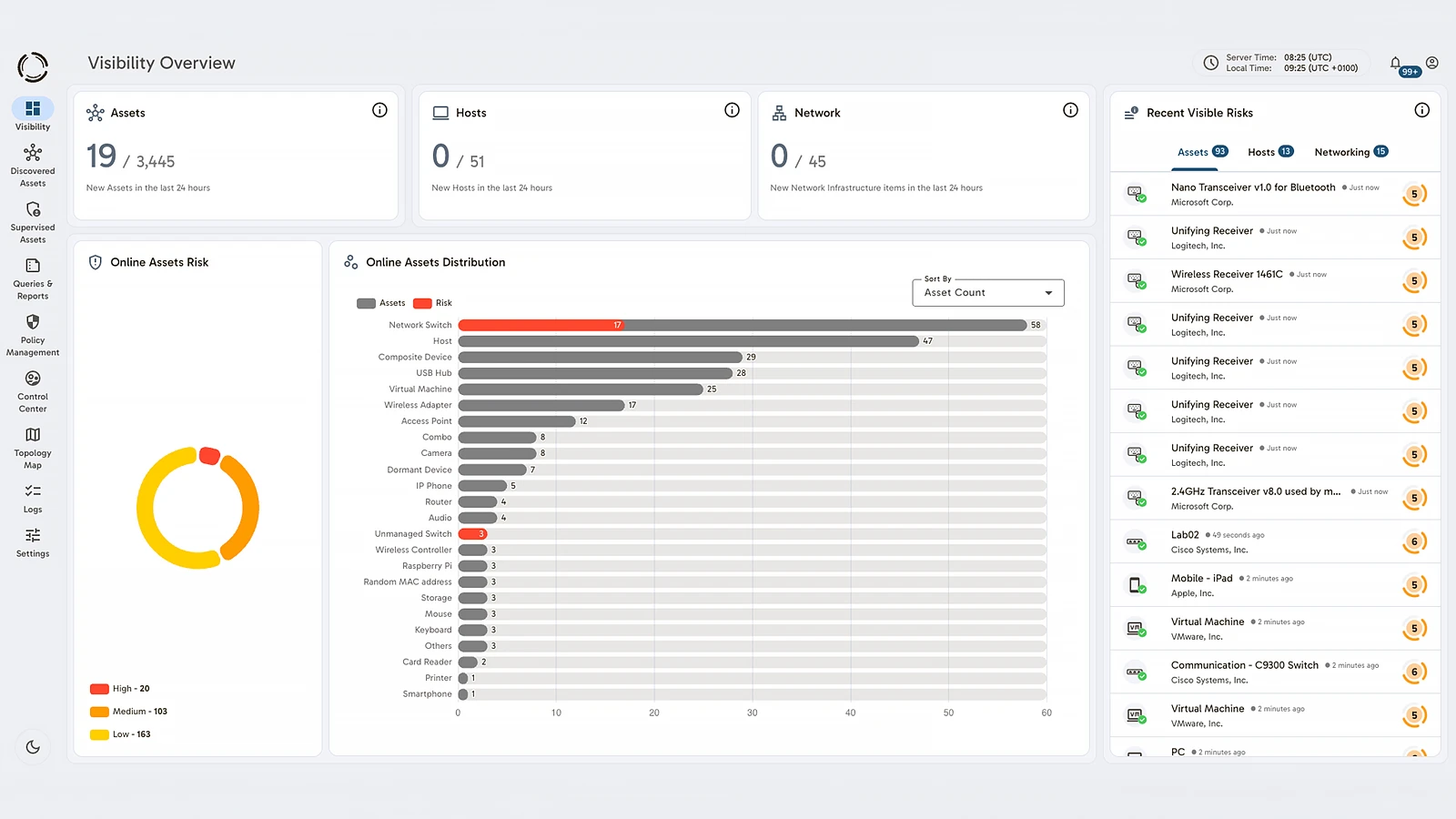
Zero Trust Hardware Access complements broader Zero Trust initiatives by providing visibility into connected hardware and validating device identity. These capabilities align closely with the NSA’s Device Pillar recommendations, which emphasize the importance of establishing trust in devices before granting access.
Complete hardware visibility
Before trust can be enforced, institutions need to know what is physically present. Zero Trust Hardware Access starts with discovering and mapping connected devices across IT, IoT, peripherals, unmanaged assets, and shadow hardware.
Identity based on evidence, not claims
Financial institutions should not rely only on what a device says it is. ZTHA shifts device trust from declared identity to verified identity using evidence, context, and physical-layer characteristics.
Continuous posture validation
Knowing what a device is is only the start. Institutions also need to know whether it is operating in the right place, in the right role, and according to policy. ZTHA supports continuous validation instead of static trust.
Explainable risk prioritization
Security and compliance teams need a way to prioritize what matters most. ZTHA ties visibility, identity, and posture into a clearer risk model so response can be more evidence-based.
Real enforcement
Zero Trust is not just about seeing issues. It is about reducing exposure. ZTHA helps support alerting, restriction, quarantine, and automated response workflows based on verified hardware identity and policy.
A Financial Services Example
Consider a branch, regional office, ATM environment, or trading location where a device is connected that looks legitimate enough to avoid immediate suspicion.
Traditional controls may see traffic. They may see a MAC address. They may see a hostname or identifier that appears acceptable.
But that still does not answer the most important question:
Is the device truly what it claims to be, and should it be here?
That is the question Zero Trust Hardware Access is built to answer.
For financial institutions, this can help uncover:
- rogue and unmanaged devices
- shadow IT introduced outside standard process
- spoofed or misrepresented assets
- unauthorized peripherals
- hardware-based attack paths that sit below or beside conventional network-centric visibility
How Zero Trust Hardware Access Supports Resilience and Governance
Zero Trust Hardware Access is not just another visibility layer. It helps financial institutions improve operational control and reduce risk where conventional Zero Trust strategies often rely on assumptions.
It can help support:
- more defensible asset inventories
- stronger risk assessments
- better enforcement of device-related policy
- improved branch and third-party visibility
- stronger support for incident response and audit readiness
- better alignment between security operations and resilience goals
Why Traditional Zero Trust Approaches Are Not Enough
Many financial institutions already use NAC, EDR, XDR, IAM, CMDBs, scanners, and monitoring tools. These remain important. But they do not always provide reliable hardware truth.
Some tools depend heavily on:
- traffic visibility
- software presence
- declared identifiers
- network participation
- managed status
- prior enrollment
That can leave gaps for devices that are silent, unmanaged, spoofed, transient, or physically present in ways that do not fit software-centric assumptions.
What Financial Institutions Should Do Next
For financial organizations evaluating Zero Trust maturity, the next step is not to replace existing controls. It is to strengthen the foundation they rely on.
A practical starting point is to ask:
- Can we see all connected hardware assets across our environment?
- Can we verify device identity based on evidence rather than claims?
- Can we continuously validate whether a device belongs, complies, and behaves as expected?
- Can we prioritize hardware risk in a way that supports both security operations and governance?
- Can we enforce policy when hardware trust fails?
If the answer to any of those questions is unclear, there is a good chance your Zero Trust strategy still has a hardware blind spot.
Zero Trust Hardware Access with Sepio
Sepio helps financial institutions extend Zero Trust to the hardware layer.
By providing visibility into connected assets, validating device identity at the physical layer, supporting risk-based policy, and enabling enforcement actions, Sepio helps financial organizations reduce blind spots and strengthen cyber resilience where many tools still rely on assumptions.
Zero Trust cannot be complete if hardware identity is assumed.
For financial institutions, Zero Trust Hardware Access is how that assumption gets replaced with proof.
Talk to Sepio about Zero Trust Hardware Access
Discover how Sepio helps financial institutions verify hardware trust, reduce blind spots, and strengthen cyber resilience across complex connected environments.
Frequently Asked Questions
Zero Trust Hardware Access (ZTHA) is a security approach that extends Zero Trust principles to the hardware layer. It requires devices to be verified for what they truly are before they are trusted to connect, communicate, or operate.
It helps financial institutions reduce blind spots related to unmanaged, rogue, spoofed, or unauthorized connected devices. That supports stronger cyber resilience, better operational control, and more reliable asset visibility.
Traditional Zero Trust often focuses on users, applications, sessions, and network access decisions. Zero Trust Hardware Access adds verified hardware identity, continuous device validation, and hardware-based policy enforcement.
Yes. By verifying hardware identity and revealing connected devices that may otherwise be missed or misclassified, Zero Trust Hardware Access helps organizations identify rogue, unmanaged, or unauthorized assets earlier and act on them faster.
Because financial institutions operate complex, distributed, and highly sensitive environments. If device trust is assumed rather than verified, security controls may be making decisions based on incomplete or misleading information. See also Sepio’s approach to cybersecurity for financial institutions.