In today’s interconnected IT, Operational Technology (OT), and Internet of Things (IoT) environments, seemingly harmless hardware devices can pose significant security risks. One such often-overlooked device is the unmanaged switch. An unmanaged switch is a plug-and-play networking device that connects multiple Ethernet devices within a local area network (LAN) without requiring configuration or management. While this simplicity makes unmanaged Ethernet switches easy to deploy, it also limits visibility and control, creating potential security blind spots.
These Ethernet switches may appear to be simple networking components, but they can introduce vulnerabilities that jeopardize an organization’s cybersecurity and create challenges for ethernet switch security programs. In this article, we will explore how unmanaged switches work, the security risks and network vulnerabilities they can create, and effective strategies for mitigating these risks to strengthen network security.
What Is an Unmanaged Switch?
An unmanaged switch is a basic networking device that connects multiple Ethernet devices within a Local Area Network (LAN). Unlike managed switches, it lacks configuration, monitoring, and management capabilities, operating automatically without administrator intervention. While unmanaged Ethernet switches are easy to deploy and cost-effective, they provide limited visibility and control, which can introduce security risks and weaken overall ethernet switch security.
- Lack of Configuration: One of the key limitations of an unmanaged switch is the absence of configuration capabilities. Network administrators cannot segment traffic, monitor activity, or enforce security policies. As a result, unmanaged Ethernet switches are often unsuitable for environments that require advanced security controls and traffic management.
- Ease of Use: While an unmanaged switch is easy to set up and deploy, this convenience comes with limited security controls and visibility. These switches generally do not provide mechanisms to control which devices can connect to the network or how traffic is managed between connected devices. This lack of control can create network blind spots and make it more difficult to detect unauthorized connections and potential cybersecurity threats.
The MITM Attack Vulnerability
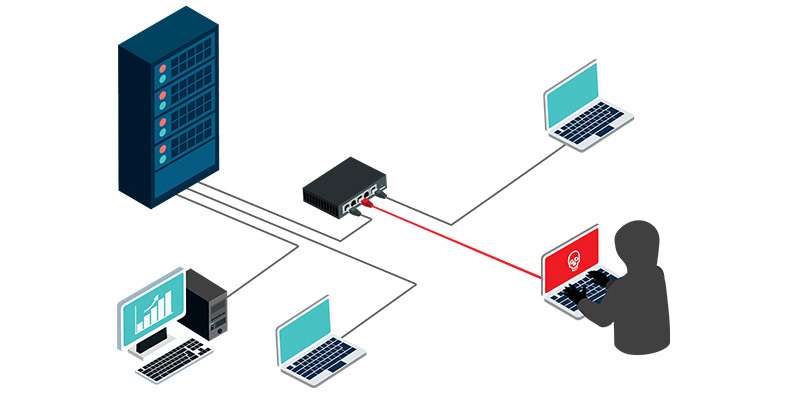
An unmanaged switch can inadvertently create a separate, unmanaged link to the public internet, bypassing an organization’s security controls and defense layers. When a malicious computer connects to this switch, it can establish a concealed connection that may provide unauthorized access to the organization’s network and sensitive data.
This type of exposure is one example of the broader security risks associated with these devices. Without adequate visibility, monitoring, or access controls, this infrastructure can create network blind spots that make malicious activity more difficult to detect.
Such environments can become fertile ground for Man-in-the-Middle (MiTM) attacks. In these attacks, an attacker secretly intercepts communications between two parties and may even alter the exchanged data, causing both parties to believe they are communicating directly.
- Bypassing Security Layers: A malicious computer connecting to an unmanaged switch can bypass the organization’s security layers, allowing unauthorized access to sensitive information.
- Data Interception: Man-in-the-Middle (MiTM) attacks can result in stolen credentials, sensitive data exposure, operational disruption, and reputational damage. Organizations should understand these risks and take steps to improve visibility into unmanaged network infrastructure.
MAC Spoofing and Reconnaissance
Moreover, unmanaged switches can be employed in the reconnaissance phase of MAC spoofing attacks. In MAC spoofing, attackers imitate a legitimate MAC address to bypass network security measures. Because unmanaged switches lack monitoring and management capabilities, detecting spoofed devices and suspicious activity can be particularly challenging. This lack of visibility can create network blind spots that enable attackers to operate without immediate detection.
Challenges in Unmanaged Switch Detection
The challenge with unmanaged switches lies in their invisibility to traditional cybersecurity systems. These switches lack identifiable characteristics at Layer 2 and above, making both the switch and any devices connected behind it difficult to detect. For example, an unmanaged hub switch does not have its own MAC address, making it effectively “MAC’less.”
Sepio’s Solution Unique Approach
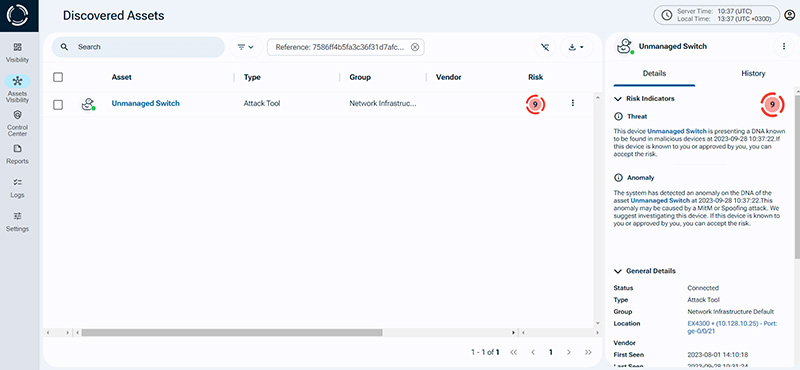
Recognizing this silent threat, Sepio’s solution uses physical layer data obtained from the physical layer of the network infrastructure to identify MAC’less devices. By alerting the security teams about such risky configurations, organizations can take proactive measures to secure their network infrastructure.
- Physical Layer Visibility: Sepio monitors the network’s physical layer to detect MAC-less devices. This helps alert security teams to risky configurations. This proactive approach enables organizations to take necessary measures to secure their networks.
- Alerting Security Teams: Organizations can configure alerts to notify security personnel when an unmanaged ethernet switch is detected. This enables a rapid response to potential threats.
Closing the Security Gap of Unmanaged Switches
Unmanaged Ethernet switches may seem simple, but they can introduce significant network security risks. Their lack of visibility, monitoring, and configuration capabilities can create opportunities for attacks such as Man-in-the-Middle (MiTM) and MAC spoofing while also creating network blind spots.
To mitigate these risks, organizations need tools that can identify unmanaged network infrastructure and the devices connected behind it. By monitoring the physical layer and generating alerts for unmanaged switches, security teams can quickly identify and address potential vulnerabilities.
Don’t wait for hidden network infrastructure to become a security risk. Schedule a demo to learn how Sepio helps organizations uncover hidden network infrastructure, identify unauthorized devices, and gain visibility across their environments.
Talk to an expertFrequently Asked Questions
These switches are not inherently insecure, but they provide limited visibility and control compared to managed switches. Because they lack monitoring, logging, and configuration capabilities, organizations may find it more difficult to detect unauthorized devices, enforce security policies, and identify suspicious network activity.
These switches can introduce several security risks, including network blind spots, unauthorized connectivity, Man-in-the-Middle (MiTM) attacks, and MAC spoofing. Without visibility into connected devices and network traffic, malicious activity may go undetected for extended periods.
A managed switch provides administrators with configuration, monitoring, and security features such as VLAN support, traffic management, and access controls. An unmanaged switch operates automatically without configuration, making it easier to deploy but limiting visibility and security oversight.
An unmanaged switch automatically forwards network traffic between connected Ethernet devices without requiring configuration. Devices can communicate as soon as they are connected, making deployment simple but providing little control over how traffic flows across the network.
No. Most switches of this type do not have an IP address because they lack management capabilities. Unlike managed switches, they generally cannot be configured or monitored through a management interface.
Yes. Because this type of infrastructure is often invisible to traditional network management and security tools, it can create blind spots within the network. Devices connected behind these switches may be difficult to identify, monitor, or secure, increasing the risk of unauthorized access and shadow IT.
Organizations can improve detection by using advanced network visibility solutions that analyze connections at the physical layer. This can help identify hidden network infrastructure and connected devices that may not be visible through traditional network monitoring methods.
Network switch security vulnerabilities can include unauthorized access, traffic interception, MAC spoofing, misconfigurations, and hidden infrastructure that bypasses security controls. Without proper visibility, these vulnerabilities can increase an organization’s attack surface and make threat detection more difficult.