Throughout my time leading technology modernization and cybersecurity across the federal government, one lesson became increasingly clear: you cannot effectively secure what you cannot confidently identify. As my teams implemented Zero Trust across complex environments, hardware intelligence proved to be a critical, and often overlooked, capability for making informed trust decisions. While identity, endpoint security, and asset management remain foundational to any successful Zero Trust implementation, Sepio provides the deep hardware intelligence that strengthens existing Zero Trust capabilities by helping agencies better understand what is connected to their environments, validate device integrity, and make more informed, risk-based trust decisions.
Federal agencies have made substantial progress in implementing Zero Trust. Identity controls are stronger, access decisions are becoming more contextual, and security teams have greater visibility across users, applications, workloads, data, and network activity.
This progress has been shaped by Executive Order 14028, OMB Memorandum M-22-09, NIST Special Publication 800-207, CISA’s Zero Trust Maturity Model, and other federal directives and technical guidance.
Together, these initiatives reinforce a central principle: trust should not be granted because of network location, ownership, credentials, or previous authorization. It should be continuously evaluated based on identity, context, policy, and risk.
Yet one important question often remains unresolved:
Can we trust the hardware requesting access?
When device identity depends primarily on software-reported information, network identifiers, credentials, or other attributes that can be copied or manipulated, the trust decision may rest on an incomplete foundation.
This creates a significant blind spot in federal Zero Trust architectures: hardware access may be assumed rather than independently verified.
The Role of Hardware Intelligence in Federal Zero Trust
OMB Memorandum M-22-09 organizes the federal Zero Trust strategy around five pillars:
- Identity
- Devices
- Networks
- Applications and workloads
- Data
Visibility, analytics, automation, orchestration, and governance span these pillars and allow agencies to make better-informed security decisions.
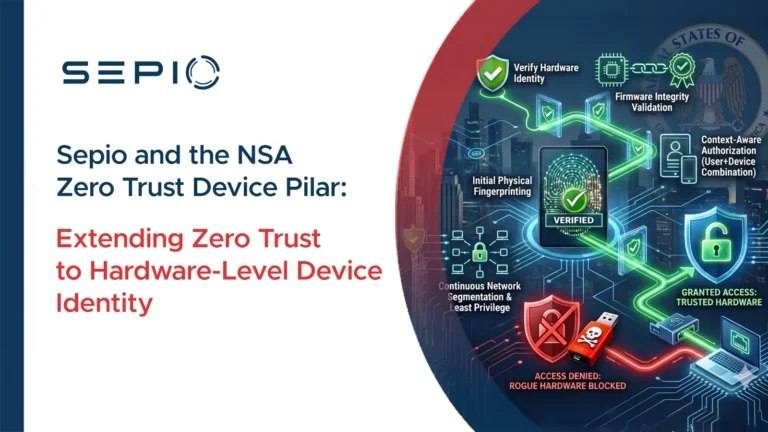
The inclusion of the device pillar is especially important. Federal Zero Trust cannot depend solely on verifying users and applications. Agencies must also determine whether the endpoint, peripheral, infrastructure component, or connected asset participating in an interaction is known, authorized, compliant, and appropriate for access.
Existing Zero Trust capabilities typically evaluate whether a user is strongly authenticated, whether an endpoint is managed, whether it complies with configuration policies, and whether the requested activity is consistent with its role.
These are necessary questions. They may not, however, establish whether the connected physical hardware is genuinely what it claims to be.
Traditional discovery and security platforms often rely on logical attributes such as MAC addresses, IP addresses, hostnames, certificates, operating-system information, installed agents, and device-generated descriptions.
These signals provide valuable context, but many are self-reported, changeable, duplicable, or spoofable.
A rogue device may imitate a trusted endpoint. An unauthorized peripheral may identify itself as a standard keyboard or storage device. A hardware implant may operate transparently between legitimate systems. An unmanaged switch or passive network component may not behave like a conventional endpoint at all.
In these cases, an agency may believe that it has verified a device when it has actually verified only the identity presented by that device.
Hardware intelligence adds another layer of evidence. It helps agencies compare claimed identity with independently observed hardware characteristics and connection context, creating a more reliable foundation for trust decisions.
What Federal Guidance Already Tells Us
NIST Special Publication 800-207 establishes the foundation for federal Zero Trust and describes a shift away from static, perimeter-based security toward protection centered on users, assets, and resources.
Trust should not be granted merely because an asset is connected to an internal network, uses an approved address, or previously appeared in an inventory.
This distinction is especially important for hardware.
A device should not automatically be trusted because it:
- Appears on an internal network
- Presents a familiar identifier
- Connects through an authorized port
- Claims to be a recognized device type
NIST’s model supports access decisions based on a continuously evaluated operational picture informed by multiple data sources.
Hardware identity and hardware-level risk can become additional inputs into this decision. They should not remain assumptions made before the Zero Trust evaluation begins.
CISA’s Zero Trust Maturity Model builds on this foundation by helping agencies progress from traditional practices toward advanced and optimal capabilities across all five pillars.
Within the device pillar, agencies are expected to improve their ability to inventory, assess, monitor, and respond to device risk. More mature device assurance requires agencies to consider not only whether an endpoint has an agent or complies with a configuration baseline, but whether the connected physical asset is actually the asset the organization expects.
Risk-Based Prioritization Requires Better Device Context
CISA’s Binding Operational Directive 26-04, “Prioritizing Security Updates Based on Risk,” reinforces the importance of directing remediation resources toward vulnerabilities and assets that present the greatest real-world risk.
Rather than treating every vulnerability or affected system identically, agencies must use relevant threat and environmental context to determine what requires the most urgent attention.
This principle extends beyond vulnerability severity. Effective prioritization depends on understanding the asset itself:
- What is the device?
- Where is it connected?
- What function does it perform?
- Is it authorized and correctly identified?
- Is its observed hardware consistent with its approved record?
- What would be the operational impact of compromise?
An agency cannot confidently prioritize risk when the identity, ownership, location, or role of the affected hardware is uncertain.
Sepio’s deep hardware intelligence can enrich risk-based prioritization by identifying devices missed by conventional tools, detecting inconsistencies between claimed and observed identities, and adding hardware-specific context to vulnerability and exposure data.
This helps agencies move from vulnerability prioritization based primarily on software findings toward prioritization informed by the actual device, its connection, its operational role, and its broader exposure.
Asset Visibility Must Be Complete and Trustworthy
CISA’s Binding Operational Directive 23-01 reinforces the importance of continuous asset discovery and vulnerability enumeration across Federal Civilian Executive Branch environments.
The directive reflects an important operational reality:
Agencies cannot protect assets they do not know exist.
But two additional questions must also be addressed:
Does the inventory include hardware that does not respond to traditional discovery methods?
Does the discovered identity accurately represent the connected physical device?
A scanner may identify an active IP address. An endpoint platform may report an operating system. A network-management platform may record a MAC address.
These observations help build an inventory, but they may not identify transparent network devices, unauthorized peripherals, agentless assets, unmanaged switches, hardware implants, or devices masquerading as approved equipment.
Asset discovery tells an agency what appears to be present.
Hardware identity verification asks a deeper question:
What is the asset really?
Strengthening Continuous Diagnostics and Mitigation
CISA’s Continuous Diagnostics and Mitigation program helps agencies improve asset management, identity and access management, network security management, and data protection.
CDM Asset Management capabilities help agencies understand which assets exist, where they are located, how they are configured, and which systems may require attention.
Hardware intelligence can strengthen this information by helping agencies:
- Discover assets missed by conventional methods
- Identify unmanaged or agentless devices
- Detect inconsistencies between reported and observed identity
- Add hardware-specific context to risk prioritization
The objective is not to create another isolated inventory.
The objective is to enrich CDM dashboards, agency data repositories, configuration-management databases, and security workflows with more complete and independently verified hardware information.
My experience as a Sepio customer demonstrated the value of this additional context. The intelligence Sepio provided helped address gaps in the information available about connected assets and contributed to a stronger, more evidence-driven Zero Trust design.ified hardware information.
Supporting FISMA and the NIST Risk Management Framework
For agencies implementing Zero Trust under the NIST Risk Management Framework, hardware visibility and identity verification can provide supporting evidence for controls and activities related to:
- System component inventory
- Continuous monitoring
- Device identification
- System integrity
- Supply-chain risk management
For example, NIST SP 800-53 control CM-8 calls for organizations to develop and maintain an accurate inventory of system components and update that inventory as components are installed or removed.
A hardware-aware approach can make this inventory more dependable. Instead of relying exclusively on logical identifiers, agencies can add independently observed hardware characteristics and risk indicators.
This additional evidence can help security teams, system owners, assessors, and authorizing officials determine whether an asset is actually present, whether it matches its approved identity, whether it has moved or changed, and whether an unauthorized component is participating in the environment.
This is the difference between maintaining an asset list and maintaining trustworthy evidence.
From Asset Inventory to Hardware Identity Verification
Federal agencies already recognize that asset inventory is foundational to cybersecurity, compliance, vulnerability management, incident response, and operational resilience.
But inventory alone is not enough.
An inventory confirms that an asset has been recorded or observed.
Hardware identity verification helps determine whether the asset is authentic, expected, and suitable for access.
This requires a shift in mindset:
From “What is connected?” to “What is it really, and should it be trusted?”
A hardware-aware Zero Trust capability should help agencies identify known and unknown assets, managed and unmanaged devices, unauthorized peripherals, transparent network components, and hardware whose observed characteristics do not match its reported identity.
This verification must also operate at federal scale.
Hardware identity verification should be deployable without requiring universal endpoint-agent coverage, network traffic mirroring, or packet decryption—particularly across distributed facilities, legacy systems, operational environments, air-gapped networks, and sensitive mission locations.
Hardware identity can then become another authoritative source of context feeding the broader Zero Trust architecture.
Closing the Hardware Trust Gap
Closing the hardware trust gap does not require agencies to replace their existing Zero Trust investments.
Rather than replacing existing security investments, Sepio strengthens existing Zero Trust capabilities by providing deep hardware intelligence that improves visibility, validates device integrity, and enables more informed, risk-based trust decisions.
Establish Continuous Hardware Visibility
Agencies should identify connected hardware beyond assets that have agents, credentials, IP addresses, or supported operating systems.
This includes endpoints, infrastructure, operational systems, IoT devices, peripherals, transparent components, and unmanaged assets.
Validate Hardware Identity
Device trust should not depend exclusively on information supplied by the device.
Agencies should compare claimed identity with independently observed hardware characteristics. A mismatch between logical identity and physical characteristics should be treated as a risk indicator requiring investigation.
Prioritize Based on Risk
Not every unknown device or hardware anomaly creates the same level of exposure.
Relevant risk indicators may include identity inconsistency, unexpected device type or location, unauthorized peripheral activity, abnormal connection characteristics, and known threat or vulnerability exposure.
These observations should contribute to a consistent risk assessment that informs investigation, policy, and remediation.emediation.
Integrate Hardware Intelligence with Existing Infrastructure
Hardware intelligence supports the cross-pillar visibility, analytics, automation, and orchestration envisioned by OMB and CISA.
Verified hardware information should enrich the platforms agencies already use, including CDM systems, configuration-management databases, network access control, endpoint security, SIEM, SOAR, IT service management, and Zero Trust policy engines.
This integration allows agencies to use hardware intelligence in the tools and workflows where operational decisions are already made.
Convert Visibility into Policy
When a device is unknown, unauthorized, or inconsistent with its approved identity, agencies should be able to initiate proportionate actions.
Depending on mission context and risk, this might include generating an alert, opening an incident, requiring additional validation, updating an asset record, restricting access, or isolating the device.
The response should be based on the device’s role and risk, not simply on whether it appears in an inventory.
Evaluate Trust Continuously
Zero Trust is not a one-time approval.
A device that was trusted yesterday may be replaced, moved, altered, tampered with, or connected through a different interface today.
Agencies should continuously evaluate whether the hardware still matches its expected identity, location, role, connection, and risk profile.
How Sepio Extends Federal Zero Trust
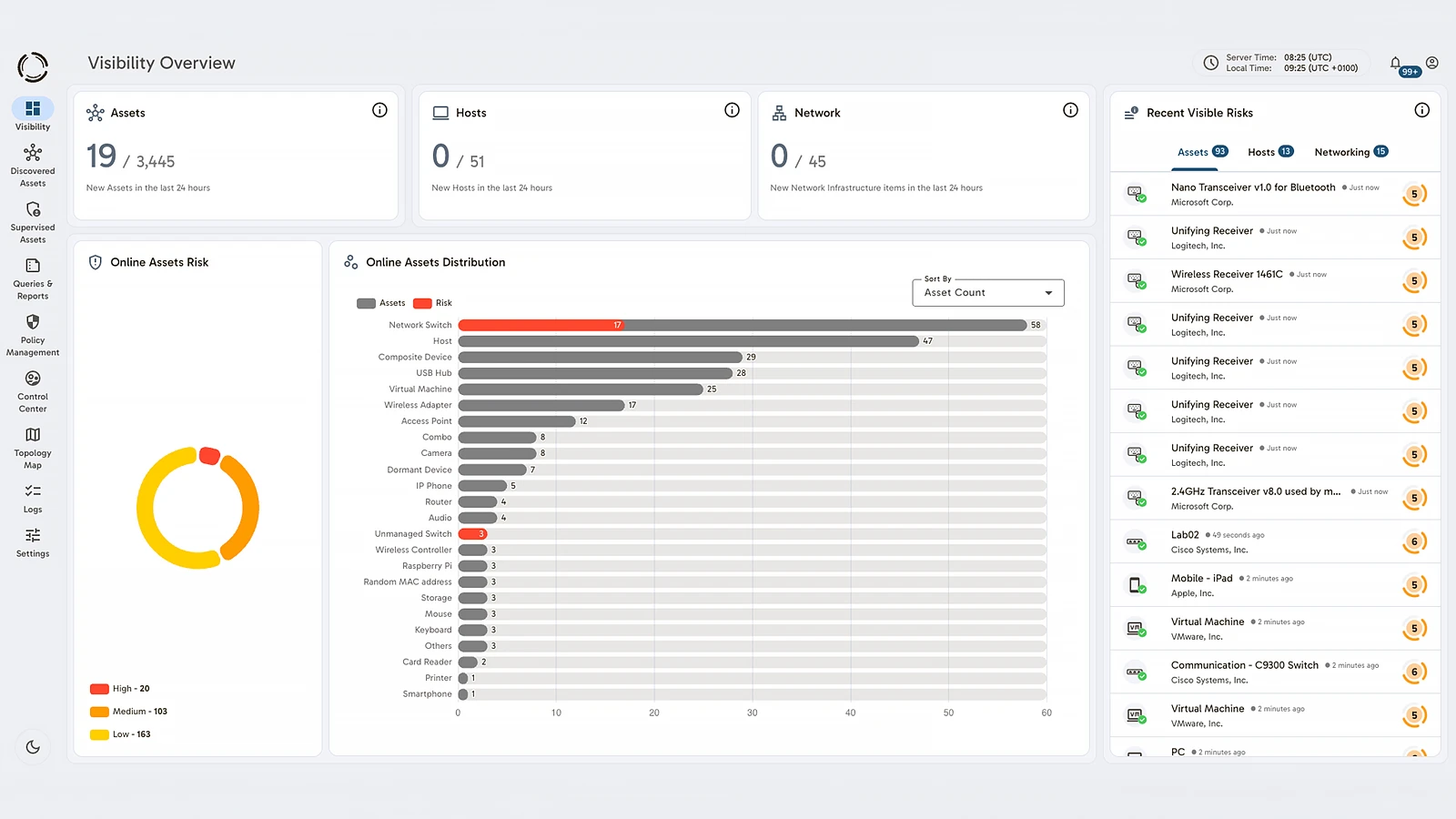
Sepio extends federal Zero Trust programs with trafficless asset discovery and deep hardware identity intelligence across IT, OT, IoT, and peripheral environments.
Using infrastructure telemetry and physical-layer device characteristics, Sepio helps agencies identify known, unknown, unmanaged, transparent, and potentially masquerading assets without requiring network traffic collection, packet decryption, sensors, probes, or universal endpoint agents.
Sepio’s hardware intelligence can enrich existing CDM, CMDB, NAC, SIEM, SOAR, ITSM, vulnerability-management, and policy-enforcement workflows.
This enables agencies to strengthen their existing investments rather than introduce another disconnected security silo.
The result is not simply a more complete inventory.
It is a more reliable basis for determining whether a device should be trusted, investigated, restricted, or isolated.
Hardware Must Become Part of the Federal Zero Trust Decision
OMB, CISA, NIST, DHS, and the Department of Defense have established a strong foundation for federal Zero Trust.
The next step is to ensure that the device pillar extends to the physical layer.
An asset should not be trusted merely because it presents a familiar MAC address, hostname, certificate, or operating-system profile. Federal agencies need confidence that the hardware itself is authentic, authorized, and consistent with policy.
Zero Trust Hardware Access (ZTHA) can help agencies:
- Improve the accuracy of asset and device information
- Strengthen CDM and existing security workflows
- Support risk-based vulnerability prioritization
- Detect unauthorized or masquerading devices
- Translate hardware visibility into operational response
The principle behind federal Zero Trust is clear:
Never trust implicitly. Verify explicitly and continuously.
That principle should apply not only to users, credentials, applications, and data, but also to every physical device requesting access.
A federal Zero Trust architecture cannot be complete until the hardware is verified too.
Talk to Sepio about Federal Zero Trust
Discover how Sepio helps federal agencies strengthen Zero Trust by providing deep hardware intelligence, validating device identity, detecting unauthorized hardware, and enabling more informed risk-based decisions aligned with the Federal Zero Trust Device Pillar.
Frequently Asked Questions
Zero Trust Hardware Access is an approach that extends Zero Trust principles to the physical device layer. It helps organizations verify whether connected hardware is authentic, authorized, expected, and suitable for access before that device is trusted within an environment.
Hardware identity matters because many device-trust decisions still rely on software-reported information, network identifiers, credentials, or other attributes that can be copied, changed, or spoofed. Federal Zero Trust programs need stronger assurance that a device is genuinely what it claims to be.
Hardware verification strengthens the federal device pillar by adding independently observed hardware characteristics and risk indicators to existing device posture, inventory, and policy decisions. This helps agencies move beyond simply knowing that a device appears on the network toward understanding whether the physical asset should be trusted.
Zero Trust Hardware Access can help improve asset visibility by identifying known, unknown, unmanaged, agentless, transparent, and potentially masquerading devices. This supports continuous discovery and helps agencies reduce blind spots that conventional tools may miss.
This approach supports the objectives of CISA BOD 23-01 and the Continuous Diagnostics and Mitigation program by improving the completeness and reliability of asset information. Hardware-level intelligence can enrich CDM dashboards, configuration-management databases, and other authoritative repositories with more dependable device context.
Hardware identity verification can provide supporting technical evidence for continuous monitoring, system component inventory, device identification, system monitoring, configuration management, and supply-chain risk management activities associated with FISMA and the NIST Risk Management Framework
Hardware trust gaps can involve unmanaged endpoints, unauthorized peripherals, transparent network devices, unmanaged switches, operational technology, industrial control systems, IoT devices, Internet of Military Things devices, legacy assets, removable media, contractor-managed systems, and hardware implants.
Traditional asset inventory focuses on recording what appears to be present. Hardware identity verification goes further by asking what the asset really is, whether it matches its approved identity, whether it has changed, and whether it should be allowed to participate in mission or business workflows.
Sepio helps federal agencies extend Zero Trust to the physical layer through trafficless asset discovery and hardware identity intelligence across IT, OT, IoT, and peripheral environments. Sepio can enrich existing CDM, CMDB, NAC, SIEM, SOAR, ITSM, vulnerability-management, and policy-enforcement workflows with hardware-level context.
The main takeaway is that a Zero Trust architecture is incomplete if it verifies users, applications, data, and logical device posture but does not verify the physical hardware requesting access. Federal agencies should treat hardware identity as part of continuous, explicit trust evaluation.